


Aldwick Beetle Wreck 3Dscan ©BDDH
Point-Based Rendering Technology
Capturing objects to create digital models has been possible for some time. Traditionally, this involved using lasers to record objects or spaces with a high degree of accuracy. These Light Detection and Ranging (LiDAR) devices were very expensive and used for applications such as reverse engineering—including the design of modelling kits—archaeology and crime scene reconstruction. When combined with Virtual Reality (VR) headsets, the resulting models allowed users to examine objects closely or step inside a captured scene. This was a game changer for archaeologists and investigators, who might otherwise have been unable to revisit a dig, a crumbling artefact or a preserved crime scene.
As the equipment became more affordable, the property sales industry also adopted the technology to create 360-degree tours.

From the early 2000s, emerging technology made it possible to create point clouds from video footage or a series of photographs. However, the computing power needed to produce photorealistic 3D images still put the technology beyond most people’s reach. It also struggled to reproduce translucent materials, complex details such as foliage, and very fine features such as hair.
A breakthrough came in 2023. Put simply, point clouds were combined with a process known as “splatting”, first described in 1991 by computer scientist Lee Westover. The approach was presented in the paper “3D Gaussian Splatting for Real-Time Radiance Field Rendering” by Kerbl, Kopanas, and Drettakis, marking the birth of 3DGS.
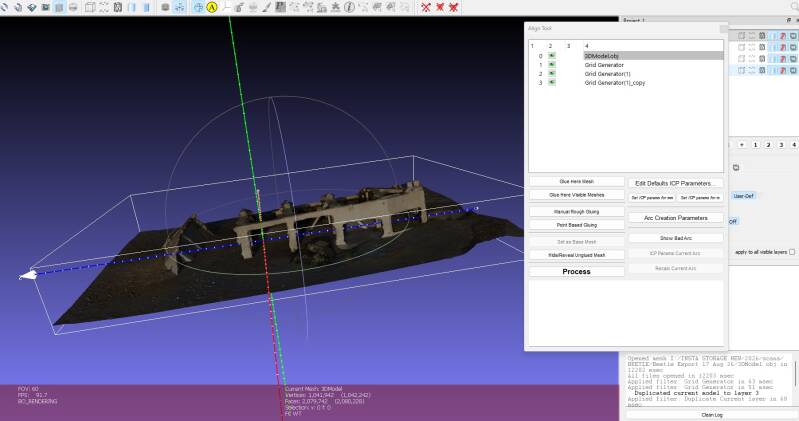
Open-source code and advances in AI helped the technology develop rapidly. We began exploring 3DGS in early 2026 as a potential enhancement to 360-degree virtual tours. Since then, applications have continued to evolve quickly, removing the need for coding knowledge and complex workflows.
Today, with just a good mobile phone camera, 3DGS enables large spaces and objects of varying sizes to be modelled at very little cost—and sometimes for free. It has not, however, replaced LiDAR where millimetre-perfect accuracy is required. For us, it opens up the possibility of capturing and digitally preserving artefacts that have previously fallen under the LiDAR!
Processing can still take several hours on PCs with Hi Spec Graphics Cards
Page Updated: November 2026